Jump start a design portfolio that gets interviews
Get the most benefit with the least effort by using this template to land the initial phone screen

Now that you’ve assessed your skills, thought about an ideal work environment, and how you would position yourself, it’s time to jump into the portfolio!
Many articles and courses have been written about portfolios. Why should you read this one? Portfolios are hard and you are your own worst client. I want to save you time and the last minute anguish you might have in polishing up that portfolio. We’ve all been there but don’t fall for this trap!
Before we start sketching or pushing pixels, let’s step back and think through the goals of your portfolio. Let’s get into the first principles.

Portfolio personas
The main goal of the online portfolio is to land the phone screen. It is not to be exhaustive in describing the rigor of your process (save that for the onsite!) but rather to start the initial conversation and continue the momentum from online, to phone screen, to an onsite interview. Be choosy in what you show here and focus on curating the best representative image of your work.
Because you will not present this portfolio — your portfolio must stand on its own. This is easy to get feedback on, send it to your friends and have them pretend to be your hiring manager.
Let’s dive into three types of personas that will be looking at your portfolio — recruiter, hiring manager, and designer.
Recruiter 👩🏽💼
A recruiter’s job is to source qualified candidates and to present them to the hiring manager. Good recruiters understand the design process, have worked with other designers before and know what a hiring manager needs. Since their job is to get as many qualified leads in the pipeline they’ll be scanning your portfolio and resume for signs of good work and process.
Goals of a recruiter,
- Source a variety of candidates through multiple channels
- Match the job requirements to the candidate
- Follow-up with promising candidates to see if they’re a good match
- Present top candidates to the hiring manager
- Get feedback from the hiring manager and repeat the process until all positions have been filled
Remember, the objective of the recruiter is to first and foremost get the right candidate for the client. You are not the client. The hiring manager is. That said there are some recruiters that go above and beyond to make sure both parties are satisfied.
Hiring Manager 👩🏻🎤
This is your future manager or potentially your manager’s manager. Unlike the recruiter they (usually) have a keen understanding of design assuming they’ve been a designer themselves but sometimes they might come from another field such as engineering, data science, or product management. In that case they might also ask their fellow designer to evaluate your work.
Goals of a hiring manager,
- Make sure your level of skill matches the job requirements
- Get a sense of your level, your seniority in design (based on scope, impact)
- Assess if you have the right balance of craft skills
- Watch out for any red flags or gaps in employment
Imagine the manager to be busy and distracted. Their work is already cut out for them and they’re drowning in responsibilities. They need more designers! That’s great! But they’re browsing your portfolio while running from one meeting to the next. They’ll glance over it for 30 seconds. If it looks interesting they’ll give it 2 more minutes. If they see good things they’ll let the recruiter set up a phone call.
Designer 👨🏻🎨
Sometimes another designer will be evaluating your portfolio as well. They could be a senior, junior or a peer to you and depending on where you’re at in the company’s interviewing process they might evaluate your portfolio in the beginning or right before your on site.
Goals of a designer,
- Help out the hiring manager source candidates
- Get a sense of what type of designer and where your strengths are
- Relay any concerns to the hiring manager
Just like the hiring manager they will have a pretty good grasp of design and they will also be looking to hire someone who can elevate the team. If they’re a junior designer they’ll be looking for mentorship.
Lead with experience
Before the portfolio start with your resume or LinkedIn. When someone will be looking over your profile they’ll want to understand your story.
- Where are you coming from?
- What have you done in the past?
- What impact were you able to deliver?
A lot of these initial impressions are based on quick scans of a profile.This is why it’s important to get the right version of your story out there. The combination of your work history and portfolio gives the recruiter and hiring manager confidence that you’ll be able to do the work and that you’re a reliable hire.
The bird’s eye evaluation,
- About you—who are you, how do you see yourself, what’s your unique perspective and what strengths do you bring to the table?
- Experience as a whole—how long have you been in this industry and what is your career and background like?
- Companies—are these well-known companies, do they have established design teams and processes?
After getting the gist, they’ll look at specific companies,
- Company name — is usually a shortcut for determining your competency. You worked at Google? That’s a plus.
- Your title—these days titles are pretty inflated (e.g. everyone’s a senior designer) so a hiring manager might skip over that but it should give them a rough benchmark of where you are in your career.
- Your responsibilities—you might have worked at Apple but what did you actually do here? What teams did you work on? The focus is on the work that was done and the complexity that you’ve encountered.
- Your impact—what outcomes were you able to achieve?
You might not have worked for the big tech companies. You might not have that magical 5+ years of experience. That’s all fine. What you can do is show how you were able to achieve the 5 years of experience in 2 years at a small company with outsize impact. Your outcomes trump everything. What metric were you able to move? What value were you able to bring to the team? Emphasize a few key outcomes that truly moved the needle.
If you don’t have concrete numbers, how else can you provide evidence of the impact you made? Perhaps there’s a strong qualitative signal you got from user research that showed your work made improvements compared to the past experience. If you don’t have that — ask your customers for a testimonial or a quote. You can even supplement that with an audio recording (with their permission) in your portfolio to make the story come to life.
Structuring your portfolio
To help you with the portfolio I’ve created folio—a free Keynote template to get you started (so now you have no excuses ;-) Download it, change it, break it, make it yours.
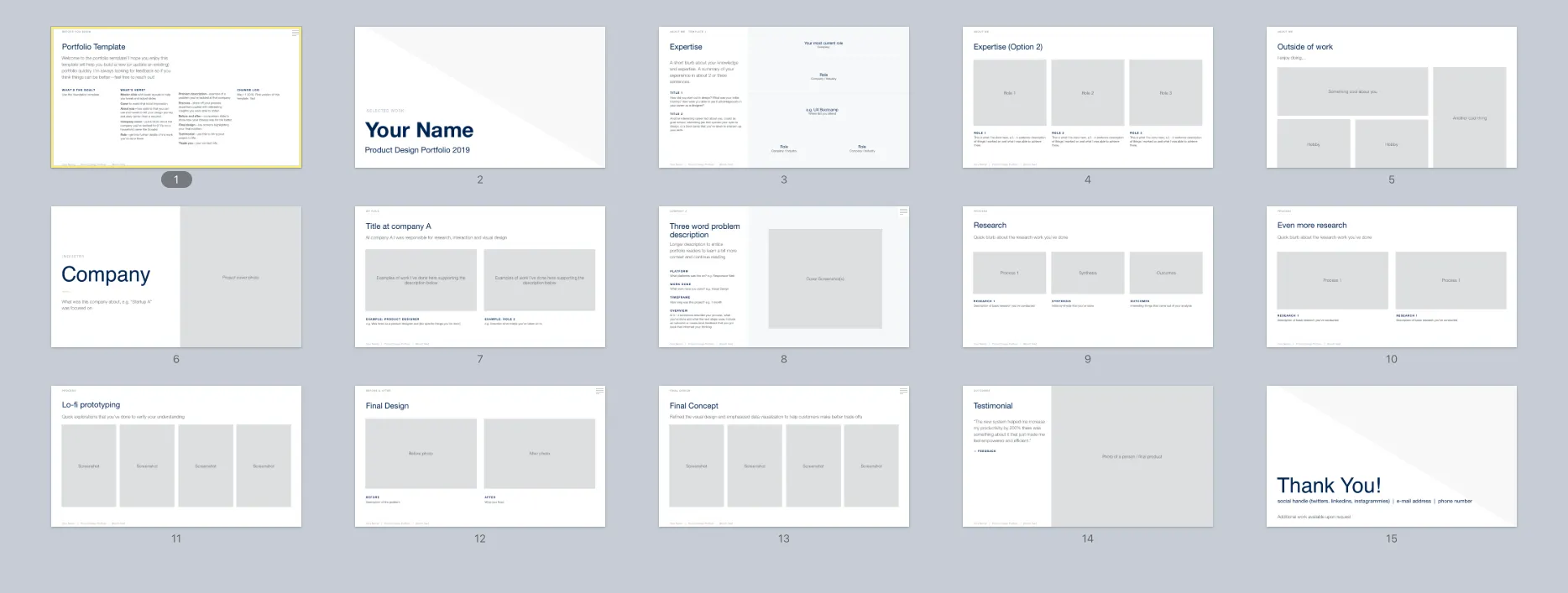
Why a deck?
Wait a second, a keynote portfolio? Shouldn’t this be a site? Won’t I get disqualified if I have a deck and not a site? So here’s the thing. If you have a template or something you’ve before to get you started — by all means go for it. If you’re starting from scratch, if your site needs a redesign, use this instead.
The goal is speed > perfection. Once you have your content you can always convert this portfolio to a site, post it as google slides but at least this will give you a starting point.
The main goal of the online portfolio is to land the phone screen
I used this approach myself. I fell into the trap of pushing pixels and making the most perfect portfolio yet… except I’ve never had the time to ship it. To keep things moving I made this deck which allowed me to customize the portfolio for specific companies. In the end this portfolio helped achieve the main goal — getting the phone call, which led to a portfolio presentation (where I used a different deck altogether for my onsite).
Portfolio outline
Your portfolio is an opportunity to present your version of the story. Remember your portfolio personas—they’re in a rush so they’ll spend less than a minute scanning through your portfolio seeing if there’s some enticing content in there to dive deep into. It’s your job as a designer to capture their attention, stop them in their tracks and make them want you.
Your portfolio must strike the right balance,
- Optimize for scanning — tweak the hierarchy to make your portfolio content easy to consume while enticing the reader to dig for more
- Support with compelling story — as the readers dive into the content, tell the story, give a narrative highlighting key facts that led to unexpected outcomes.
At a high level your portfolio should follow this structure,
- Intro—your name, date of your portfolio
- Experience — a short summary of your story, how you came to design, experiences you’ve had and what makes you a strong designer
- Personality — fun slide to include of who you are as a person
- Projects — ideally a couple of recent projects that show breadth and depth of your thinking and doing that highlight your strengths as a designer
- Thank you—closing slide with your email, social networks and phone number
The projects are the meat of your portfolio but don’t forget the context. Even little things such as having a portfolio title with your name, giving a little background of who you are is helpful. It makes you stand out as a designer, a person — not just a nameless portfolio deck in a stack of applicants. Don’t miss this chance to make a good impression here.
Which projects should I pick?
Remember this is your high level portfolio, so feel free to pick a couple of projects that do justice in representing your skills. Ideally this is your most recent, best work but it’s ok to include projects that aren’t the latest as long as it’s still work you’re proud to show. If you’re not proud of it — don’t show it, a portfolio is meant to be a curated collection of work not an exhaustive set.
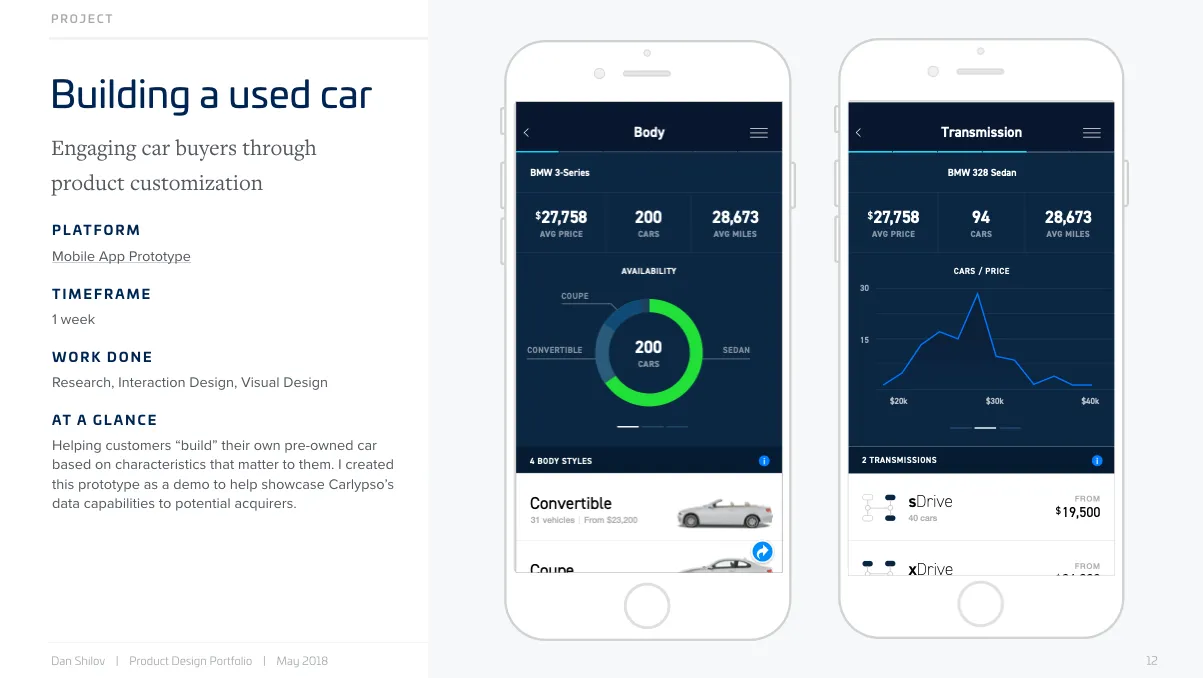
Project Outline
In essence, a successful project is one that has been able to meet or exceed a goal based on measured outcomes with least amount of effort.
- Summary — project title, quick summary, platform, your role, project timespan, key screenshots that capture the essence of a project
- Process — how did you approach the problem, pull out a couple of methods that you’ve use and explain how you used them to inform your decision making. Use this to highlight your expertise but don’t be formulaic, show where you’ve bent the process to achieve outcomes.
- Outcomes — what was the end result? You can highlight the metrics that were moved, the before and after, and the outcomes that were achieved. Sometimes it makes sense to put this section at the end but you can also put it ahead of process to entice the reader to dive in.
That’s it! The basic format should carry you through but be sure to make it your own.
Playing to your strengths
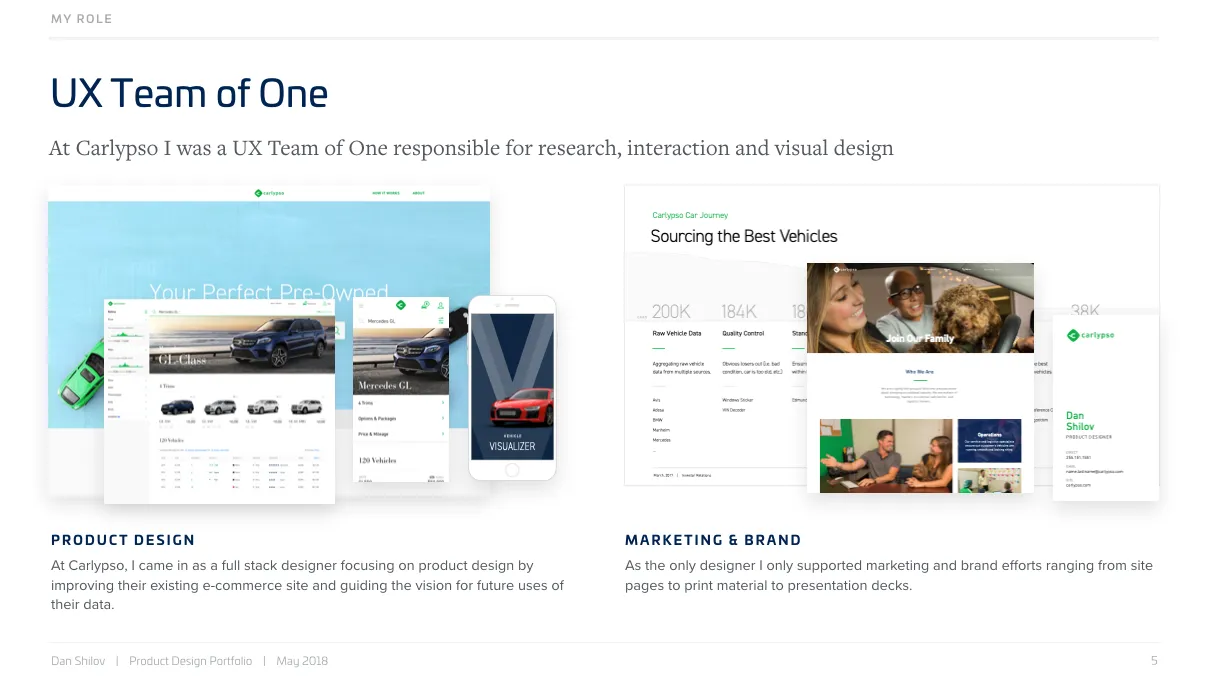
Play to your strengths and include things that might make you stand out as a candidate. If you’ve worked in smaller companies or in small and barely existing design teams — own that. If you were the only designer there tell the story of how you stepped up to the role and went above and beyond.
Portfolio growth hacks
Think about your online site as a landing hub. A place where you have a good control of what you want to show. Within this landing hub you have content about yourself, your curated work in the form of a portfolio, as well as any other side projects you’re working on that make you stand out.
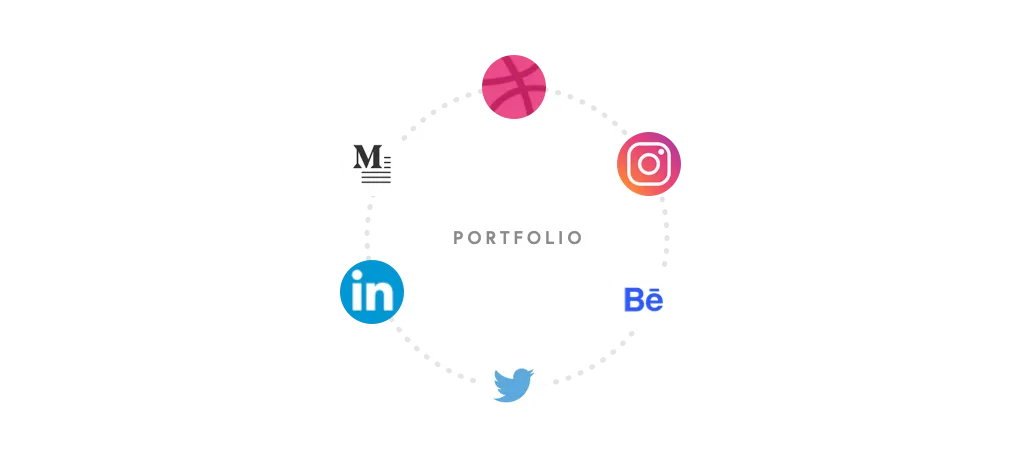
To get visitors in there are many channels that exist to promote online portfolios — Dribbble, Behance, Squarespace, LinkedIn. You should consider using all of them. In the article that follows we’ll look at how to use passive and active strategies to entice recruiters and put part of the job search on autopilot.
Concluding thoughts
The work that we do as product designers is hard. It’s not easy to capture the complexity of product design in a couple of slides when the reality is that it takes extensive skills from craft to collaboration. Getting a solid baseline portfolio out there is a first strong step towards landing the dream gig!
What’s next?
This article is part of a series—Mastering Product Design Interviews. Check out my next article on how to connect with employers beyond the job boards via referrals, direct outreach, and other strategies,
Additional resources
My colleague Tanaya Joshi at Instacart has done a fantastic job of putting together a course on How to Develop a Sound Product Design Portfolio on Skillshare. Check it out!
Julie Zhuo, VP of Design at Facebook tweeted about truly great design portfolios,
[Embedded content: Julie Zhuo on Twitter]
Here’s an additional perspective from a recruiter that I’ve found helpful,
Acknowledgements
Thank you to Angela Liu for a read through and pointing out mistakes! Big thank you to Marta Fuentealba for helpful suggestions!
Looking to get an edge in UX/Product Design interviews?
You can find this and the most up to date content in my newest book — Land Your Dream Design Job publishing with Holloway October 2020. Order today to get an early bird discount of 15%.