Hiring your product design job, part 2: choosing worthy problems
Choose between in-house design or design agency, consumer or enterprise, new or mature platforms
In the first part of hiring your product design job we talked about finding the right environment for you to flourish based on the company’s design maturity, your potential future manager and culture.
In addition to environmental factors you should also take your personal career growth preferences into account by thinking about,
- In-house or design agency roles
- Consumer or enterprise problems?
- Platforms: building on top of existing patterns or inventing new ones?
If you haven’t started already, feel free to follow along by grabbing the dream job template which you can copy and use to brainstorm your potential futures.
In-house or design agency?
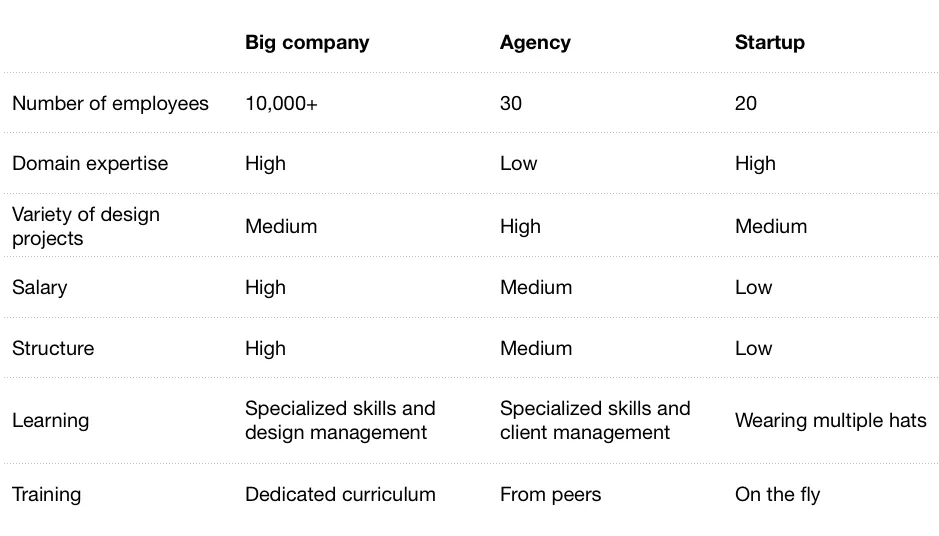
In-house (big company or startup) and agency roles offer different advantages. This is a simplified model but it should give you a rough idea of the work you’d be doing at those types of companies.
Big company in-house design
As an in-house designer at a big company you’ll have the opportunity to master the industry the company is operating in. You’ll be responsible for seeing how a project gets built all the way to the end and then track it afterwards. Your work may never be cleanly finished (compared to an agency) but that’s ok because you’ll develop a deeper understanding of your company and the market.
Another way to think about in-house is which domain do you want to operate in. In large tech companies (think Google) you could work on a variety of different projects. In non-tech companies you’ll still have project variety but you’ll be focused on a specific industry, e.g. healthcare (see next article about industry specialization).
In a larger company you’ll have the advantage of learning from other designers. You’ll also most likely have horizontal mobility to try out different teams and roles and the vertical mobility to climb the corporate ladder either as an individual contributor or move into management.
Startup in-house design
An in-house designer at startup is typically a generalist who wears multiple hats. You’ll have autonomy and if you’re the only designer — you’ll be running the show. This could prove a double edged sword as you’ll have to continuously learn how to triage and prioritize your time to ship work without burning out. Most likely the design won’t be perfect and corners will be cut to get things out quickly.
If you’re starting off new this could be a bit a sink or swim type of environment. It’s helpful to get perspective and mentorship outside of the company. Startups also typically offer lower pay, are high risk but high reward environment. However that’s not a bad thing (even if you do end up in one that’s going through a downturn) and if you’re comfortable with ambiguity this could be a great way to learn and make an impact on large projects.
At a startup since you’ll be knees deep in work and you’ll most likely develop deep professional relationships. If this company goes well, these connections can last for decades to come — maybe even help you launch your startup someday. But even if things go completely south — you’ll have a mutual bond of going through a tough experience.
Unlike a large company though, you won’t be able to easily move around if you don’t end up getting along with your workers. Startups also face the challenge of being selective in hiring for the right person for a reason yet paradoxically they’re desperate for help but have little to offer in cash (thus the higher compensation in equity).
Agency
At an agency you’ll be surrounded by top designers, in fact it’s another great place to start off and hone your craft if you’re new. Here you’ll be able to grow quickly and learn from your peers and mentors. In most agencies, design itself is the product.
Usually agencies pay lower and the hours can be long. As a result — not many designers stay in agencies long-term. The ones who continue, usually end up in client management roles, which are less craft focused and require collaboration and business savvy.
The focus of the agencies varies but in general, they offer a variety of projects which can be a great way to test and expand your design skill set. One day you might be working for a project on transportation, another on healthcare, and the next day could be completely different.
You probably won’t be able to go very deep and grasp the nuances of each domain but that’s ok because you’ll have a broad skill set that you could (in theory) apply anywhere else you feel most passionate about. If you’re not committed to a specific industry, agencies are a great way to test out the waters.
In closing, agencies are in an interesting transition time these days. Over the last couple of years large consulting (e.g. McKinsey) and tech companies (e.g. Facebook) have been buying up agencies left and right. According to John Maeda’s [Design in Tech report](http://In the last 12 months there were 19 acquisitions of creative agencies and companie) 19 agencies bought in the last 12 months. So if you do end up at a large company, you may find yourself working for an agency inside the company or working closely with them.
Consumer or enterprise?
If you’re going in-house, there are two more factors to consider enterprise or consumer. If you’re going the agency route most specialize in consumer products but there are some that exclusively focus on complex enterprise apps.
Consumer / B2C / 1 to many
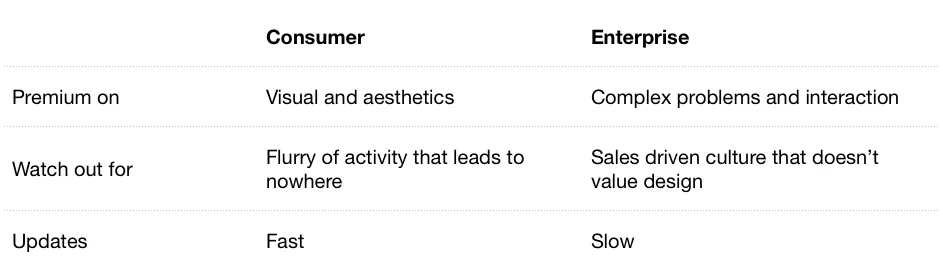
By the nature of their business, consumer companies are more aligned with their customers. This means that they have to provide an amazing experience right out of the gate that can’t be covered up by sales or marketing. Usually these companies tend to favor designers with a high visual design acumen but that’s not always the case and some consumer companies might have a stronger service design and interaction design components especially if those companies bridge the digital and physical realms (e.g. Eventbrite, Getaround).
Consumer companies are usually the ones that are in the news since they try to appeal to a broad segment of consumers…
You can continue reading an updated and refreshed version of this article on Holloway—Designing at a large company, agency, or startup.
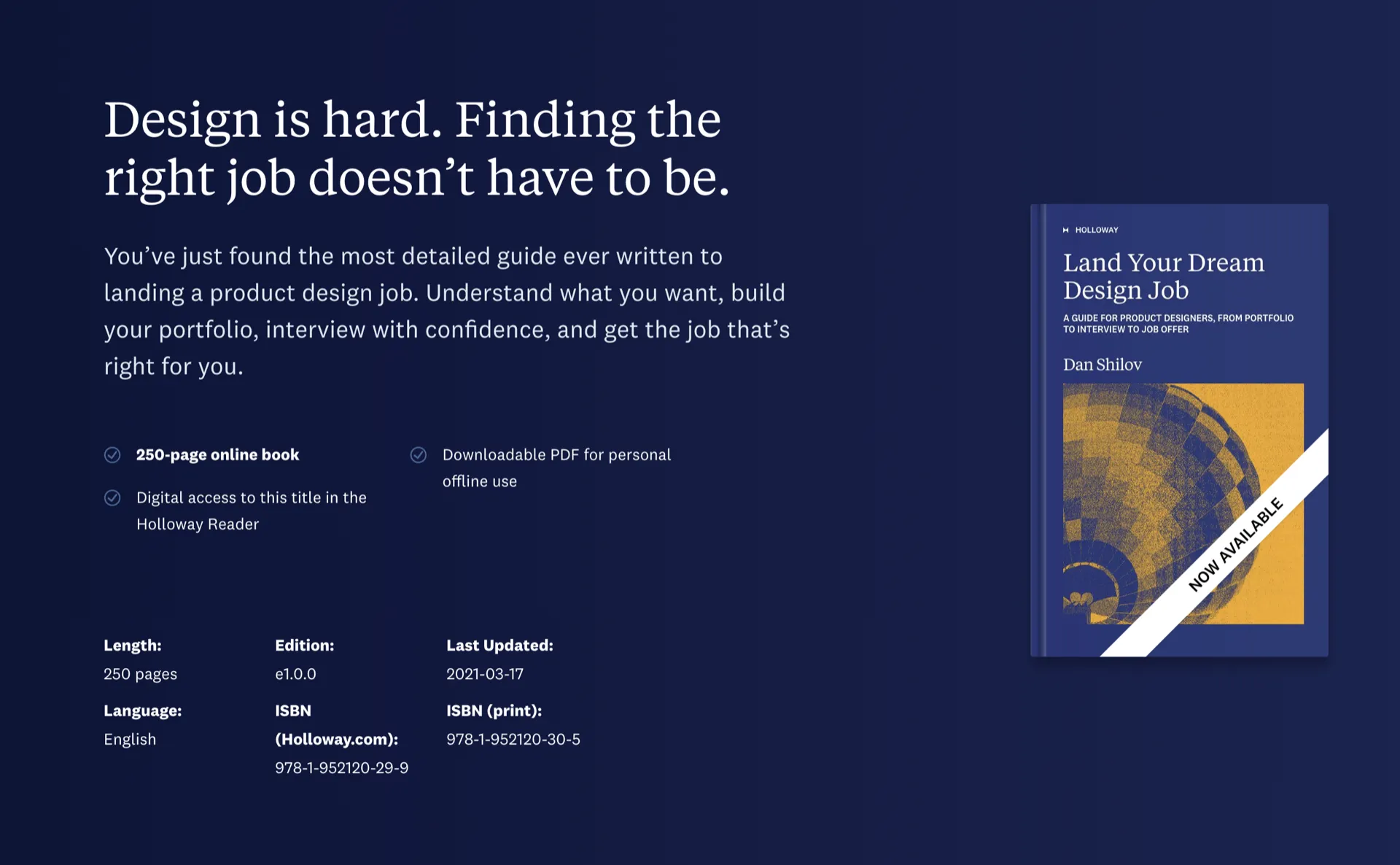
*Land Your Dream Design Job* is a comprehensive book about landing a product design role in a startup, agency, or tech company. It covers the entire design interview process from beginning to end, and will arm you with techniques and strategies to navigate the (at times) turbulent waters of job searching with confidence. This book will help guide you to a role that plays to your strengths while providing enough support for professional growth.
You’ll learn:
- What skills are expected of designers
- How to demonstrate those skills throughout the job search process
- How to identify your next opportunity
- How to target your job search process to stand out
- How to build a stand-out portfolio and tailor it to your dream opportunity
- The ins and outs of various design interview types from portfolio presentations, whiteboard challenges, app critiques, to take home design exercises and many others.
You’ll also find in-depth advice on how to apply beyond the job boards, and how to conduct due diligence, negotiate compensation, and accelerate onboarding to your new role.